Low-frequency magnetic fields, from the power line to the panel
The wires that bring power down your street and through your walls carry alternating current, and current makes a magnetic field. This site is about that field, the 60 hertz kind found near power lines, house wiring and appliances, and about what public measurements and the major research reviews say about it.
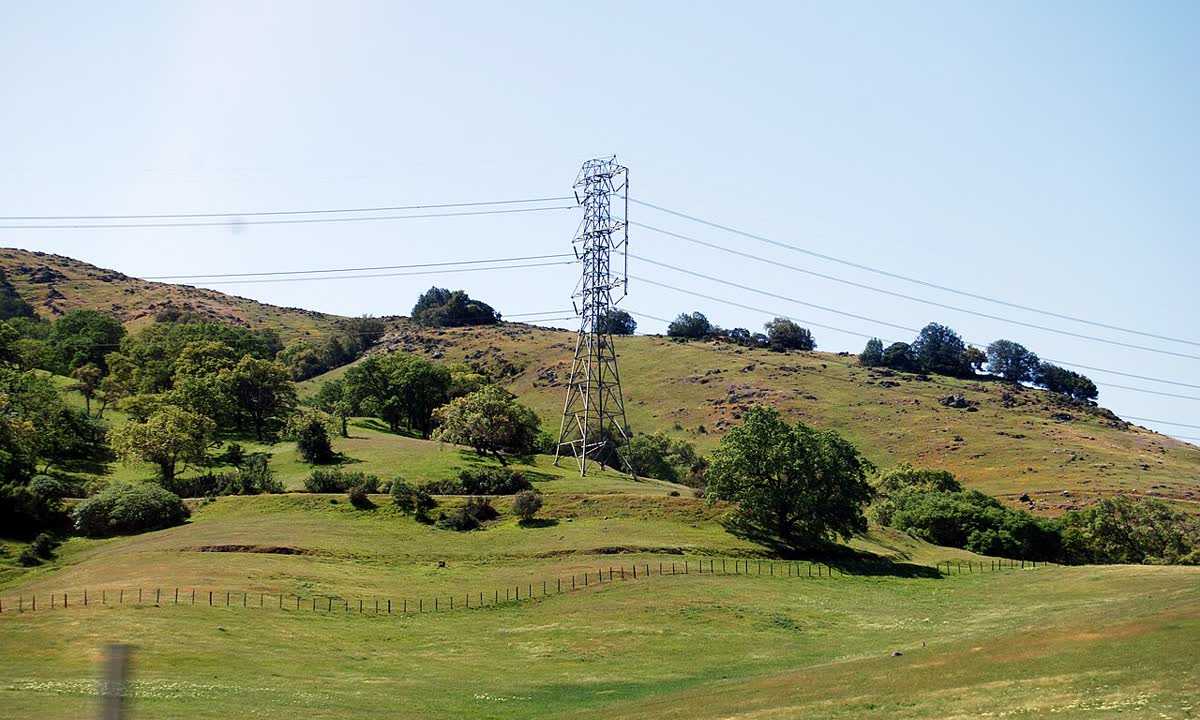
The average home in a 992-home US survey read under 1 milligauss, room by room and away from appliances. Right beside a big transmission line at average load the field is in the tens of milligauss. The international reference level for the public is 2,000 milligauss.
Two kinds of field that both get called EMF
Electric power in North America alternates 60 times a second, or 60 Hz. The 2002 NIEHS booklet on power-line fields defines the extremely low frequency (ELF) band as 3 to 3,000 Hz. The National Cancer Institute's fact sheet on electromagnetic fields puts the ELF ceiling lower, at 300 Hz. On either definition, the radio-frequency energy used by phones, Wi-Fi and cell towers sits far higher: NCI gives the RF range as 3 kilohertz to 300 gigahertz.
The gap is more than a label. NIEHS notes that power-frequency fields carry very little energy, do not ionize and usually do not heat tissue, and it calls the fields from cell phones "quite different" from those of power lines. ICNIRP's low-frequency guidelines stop at 100 kHz and leave higher frequencies to separate rules. We cover only the low-frequency side.
At 60 Hz the electric and magnetic fields also behave differently. Voltage produces the electric field, and conducting things such as trees, walls and even skin weaken it. Current produces the magnetic field, which passes through most materials and is present only while current flows (NIEHS booklet, June 2002). Most of the health research has looked at the magnetic field, and so does this site.
Milligauss and microtesla
- 1 µT = 10 mG
- Multiply microtesla by 10 to get milligauss. A 0.4 µT study cutpoint is 4 mG
- 0.9 mG
- Mean of the room-by-room averages in 992 US homes, measured away from appliances
- 57.5 mG
- Beside a 230 kV transmission line at average load. It drops to 7.1 mG at 100 feet
- 2,000 mG
- ICNIRP's 2010 reference level for the general public at 50 and 60 Hz
Source: NIEHS 2002 booklet, pages 6, 32 and 37; ICNIRP 2010 guidelines, Table 4.
American meters and utility handouts usually report milligauss (mG). International guidelines and most journal papers use microtesla (µT). Keep the factor of ten in mind and the two literatures line up.
Typical levels, from the bedroom to the right-of-way
| Where | Typical magnetic field | Source |
|---|---|---|
| Average US person, 24-hour average | Under 2 mG for most people; 6.3% above 3 mG | NIEHS 2002, survey of about 1,000 people |
| US home, room-by-room average away from appliances | Median 0.6 mG, mean 0.9 mG | EPRI study of 992 homes, in NIEHS 2002 |
| Average home field, North America | 0.11 µT (1.1 mG) | WHO, 2007 |
| Under a distribution line (4 to 24 kV) | 10 to 20 mG under main feeders, under 10 mG under laterals | NIEHS 2002 |
| Beside a 230 kV transmission line, average load | 57.5 mG; 7.1 mG at 100 ft; 1.8 mG at 200 ft | NIEHS 2002, Bonneville Power Administration data |
| Under power lines, as a general figure | About 20 µT (200 mG) | WHO, 2007 |
Two habits make these numbers easier to read. Check the distance first, because the field from a line or an appliance falls off quickly as you move away. Then check the load: a line's magnetic field rises and falls with the current it carries, so one reading is a snapshot. Our page on power line fields by distance goes through the NIEHS tables, and the one on house wiring covers fields that start inside the walls.
What IARC and WHO concluded
In 2002 the International Agency for Research on Cancer placed extremely low frequency magnetic fields in Group 2B, "possibly carcinogenic to humans," in IARC Monograph 80. The human evidence, from childhood leukemia studies, was rated limited, and the animal evidence inadequate. IARC has given radio-frequency fields the same 2B label in a separate evaluation based on wireless phone studies.
WHO's 2007 assessment, Environmental Health Criteria 238, called the leukemia evidence "not strong enough to be considered causal" but strong enough to remain a concern. It also estimated that only 1% to 4% of children have average home exposures above 0.3 µT, the range where the extra risk showed up. Our childhood leukemia page sets the pooled studies side by side.
The limits that exist
The 2002 NIEHS booklet reported no federal US standard for 60 Hz fields in homes or workplaces. Florida and New York had magnetic field limits at the edge of transmission rights-of-way. Two international documents set numbers:
- The ICNIRP 2010 guidelines give a public reference level of 200 µT (2,000 mG) and a worker level of 1,000 µT for 50 and 60 Hz fields (ICNIRP 2010 PDF).
- The IEEE standard C95.6-2002, as summarized by WHO, sets 904 µT (9,040 mG) for the public at 60 Hz and 2,710 µT for occupational exposure.
These limits guard against short-term effects of strong fields, such as nerve stimulation. ICNIRP wrote that the childhood leukemia evidence is "too weak to form the basis for exposure guidelines."
People do different things after reading this material. Some ask their utility for a free measurement, and some move a bed away from an electrical panel. Others buy consumer products, for example the EMF stickers that EMFCALM sells in packs for phones, tablets, laptops and routers. Those are wireless devices, outside the 60 Hz subject of this site, and we don't test or rate such products.
A reading means little without the conditions written next to it: where the meter was, when it was taken and what was drawing current. The published tables on this site come with theirs, such as the height above ground, the load on the line and the distance. A number from your own house deserves the same notes.
Field at the Fence explains extremely low frequency magnetic fields, the kind that come from power lines and household wiring, using published measurements and the research agencies rely on. It is not an engineering firm or a medical source.