When the magnetic field in your house comes from the wiring
Measured away from appliances, most American homes average under 1 milligauss, and that background comes mainly from household wiring and the lines outside. When the middle of a room reads well above that, the usual suspect is current flowing where it shouldn't: on a water pipe, through a wiring mistake, or on a circuit whose outgoing and returning currents don't cancel. NIEHS calls incorrect wiring "a common source of higher-than-usual magnetic fields."
What a normal reading looks like
The home baseline NIEHS uses comes from an Electric Power Research Institute survey of 992 homes (Zaffanella, 1993), reprinted in the June 2002 NIEHS booklet. Spot readings were taken in the center of each room, away from appliances, and all the rooms in a house were averaged.
Spot readings in the center of rooms, away from appliances, averaged over all rooms in each house.
| Average field above | Share of homes |
|---|---|
| 0.6 mG | 50% |
| 1.1 mG | 25% |
| 2.1 mG | 15% |
| 2.9 mG | 5% |
| 6.6 mG | 1% |
Source: NIEHS 2002 booklet, page 32, from Zaffanella 1993 (EPRI).
The mean across all houses was 0.9 mG. NIEHS adds that about 4.5% of US homes have fields above 3 mG and 2.5% above 4 mG. The booklet also warns that the chart shows whole-house averages and not the single highest spot in a house, so a 3 mG reading beside one wall is not comparable to the 2.9 mG bar.
Why most wiring makes very little field
A magnetic field comes from current, and currents flowing in opposite directions close together largely cancel. WHO's Environmental Health Criteria 238 uses appliances to explain it: when a current is balanced by a return current a short distance away, the field is comparatively small. The same logic applies to a circuit: if all the current going out comes back through the same cable, the currents add up to zero.
Trouble starts when the sum of the currents in a line is no longer zero. Engineers call that leftover a net current. WHO lists three ways it arises in homes:
- The utility's neutral is grounded at many points along a line. Table 8 of the WHO review says multiple grounding of the neutral is universal in the USA. At each of those points some neutral current can leave the line and find another way back to the transformer, through the earth or, more often, through a metal water pipe.
- Two neighboring distribution circuits meet and their neutrals are connected.
- Faulty house wiring or a faulty appliance creates an unintended connection between neutral and ground. WHO says this probably happens in 20% or more of UK homes and is also common in the US.
Net current, the usual source of background field
Net currents are small, typically a fraction of an amp to a few amps, according to the WHO review. Because the return path is far away, little of their field cancels. In homes far from transmission lines, which WHO says is most homes in most countries, the field from net current is usually the dominant source of what engineers call the background field. It falls off only as one over the distance, so it stays fairly even from room to room.
The way American homes are fed matters here. WHO describes the US supply as two phases (WHO uses 110 volts each), with some appliances connected across both at 220 volts. Those add no neutral current. Appliances on a single phase do add to it, and the neutral current depends on the difference between the loads on the two phases, not on the total load. As loads switch on and off, the neutral current changes, and WHO notes that net currents and the background they create usually follow daily patterns, even with no appliance nearby.
Wiring errors and other in-house sources
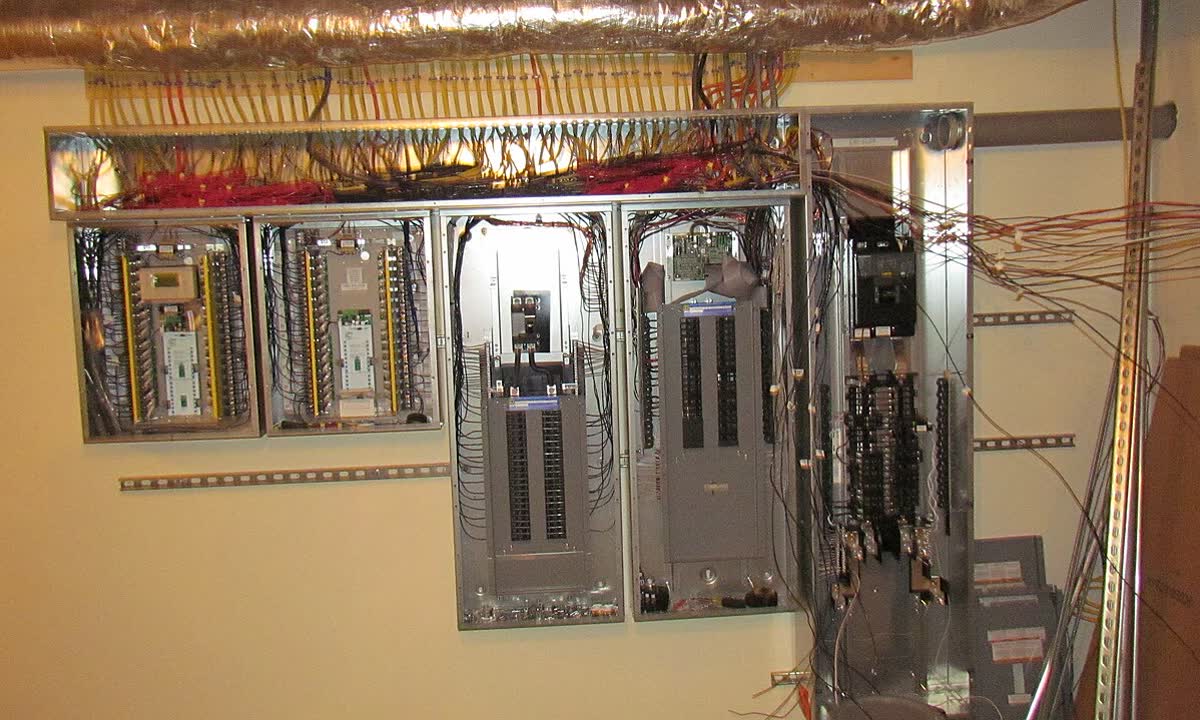
Two in-house wiring patterns show up in the WHO review. One is the neutral-to-ground contact described above. The other involves a light controlled from two switches, which WHO calls two-way switching. Wired the standard way it produces no net current. Wired the way the room layout often tempts an installer, it creates a loop of current around part of the house, and that loop makes a field only while the light is on.
NIEHS's 1999 report to Congress was direct about what drives exposure in individual homes: the "chief causes are improper grounding and improper wiring," and following current electrical codes can fix them. The 2002 booklet adds that wiring problems are worth fixing for safety reasons anyway.
Outside sources still matter. In the UK Childhood Cancer Study, WHO reports, more than half of the time-averaged exposures above 0.4 µT (4 mG) came from sources other than high-voltage power lines.
| Source in or near the house | What drives the field | How it behaves | Primary source |
|---|---|---|---|
| Net current on the supply and grounding path | Neutral current returning through earth, pipes or other circuits | Fairly even across rooms, falls as 1/distance; usually a fraction of an amp to a few amps | WHO EHC 238 |
| Current on metal water pipes | Diverted neutral current | A zone of higher field along the pipe's route | WHO EHC 238 |
| Neutral touching ground inside the house | Faulty wiring or a faulty appliance | Creates a net current; probably in 20% or more of UK homes, common in US | WHO EHC 238 |
| Light controlled from two switches, miswired | A current loop enclosing part of the house | Present only while that light is on | WHO EHC 238 |
| Electrical panel and heavily used circuits | Load current in the wiring | Local; NIEHS suggests moving a bed or chair farther away | NIEHS 2002 |
| Appliances | Motors, transformers, heating loops | Strong up close, falls as 1/r³, merges into background beyond 1 to 2 meters | WHO EHC 238 |
| Lines outside | Load current on the line | Depends on distance and load | NIEHS 2002 |
WHO also notes that the most common in-home source overall is appliances, not fixed wiring. Their fields drop so fast that a meter or two away they blend into the background. EPRI's readings were taken away from appliances, so the chart above mostly reflects wiring and outside lines.
What a gaussmeter reading means
One axis or three
A magnetic field has a direction as well as a strength. The NIOSH Manual for Measuring Occupational Electric and Magnetic Field Exposures defines the standard figure, the resultant, as the square root of the sum of the squares of three perpendicular components: B = √(Bx² + By² + Bz²). A three-axis meter combines the three for you. A single-axis meter sees only the part of the field lined up with its coil, so the older NIOSH protocol had the user read it in three perpendicular orientations and do the math afterward.
Example: a single-axis meter reads 3.0 mG pointing north-south, 2.0 mG east-west and 1.0 mG vertically. The resultant is √(9 + 4 + 1) = √14, about 3.7 mG. Any one of the three readings alone would understate it.
Spot readings and time-weighted averages
NIEHS defines a spot measurement as an instantaneous or very short reading, for example 30 seconds, at one location. A time-weighted average combines many readings over hours. Many of the leukemia studies used averages, often over 24 to 48 hours in a child's bedroom, and the WHO review explains why: spot readings miss changes over time, and a UK home's field typically swings by a factor of 2 above and below its daily average and by 25% around its yearly average.
Example: a bedroom reads 0.5 mG for 22 hours a day and 6 mG for the 2 hours when a particular circuit is in heavy use. A spot reading would give either 0.5 or 6 depending on the minute. The time-weighted average is (0.5 × 22 + 6 × 2) ÷ 24, or about 1.0 mG.
What the number does not tell you
NIOSH's 1996 booklet EMF in the Workplace took up the question of whether 2 mG is a meaningful level. It explained that studies used 2 or 3 mG as arbitrary cutoffs and said that treating 2 mG as a safety threshold "is to read far too much into the data." Our page on the childhood leukemia studies covers what the higher cutpoints of 0.3 and 0.4 µT mean.
A survey routine you can repeat
- Take readings in the center of each room, away from appliances, the way the EPRI survey did.
- Write down the meter location, the time and what was running, as the NIOSH booklet recommends for every spot reading.
- Repeat at a busy time of day and a quiet one.
- Average the rooms and compare the result with the EPRI chart above.
- Note any spot that stays high along a pipe or cable run, or that appears only when one light is switched on.
- Ask your utility. NIEHS reported in 1999 that many US utilities will measure fields in customers' homes and help find sources. SDG&E's request form covers indoor rooms plus the entry, the four corners of the property, the smart meter and any solar inverter, though SDG&E says it won't interpret the results.
What to ask a licensed electrician
- Is current flowing on the water pipe or the grounding conductor, and how much?
- Is there anywhere inside the house where neutral touches ground, either in the wiring or through an appliance?
- Are the neutrals from two different circuits joined anywhere?
- How are the lights controlled from two switches wired?
- Does the grounding and wiring meet the current code?
- Would the fix create any new hazard? NIEHS says no step to cut exposure should increase a known safety risk.
If you hire an EMF consultant instead, ask how they measure. NIOSH noted in 1996 that governments do not standardize EMF measurements or certify the people who make them.
Questions about consumer products belong with the companies selling them. Products in the category stores call anti-radiation stickers are sold for phones, tablets and routers. If you have a question about one of those packs, you can write to EMFCALM, one shop that sells them. We don't review those products here, and a wiring fault is a job for an electrician.
If a reading drops when one light goes off, or follows a pipe across the basement ceiling, write that down before anyone comes out. Those two details narrow the list of likely causes to the ones WHO describes, and they cost nothing but a notebook and an afternoon with the meter.